
Bubbles, crashes, rallies, and corrections
Fundamental, cyclical, and emotional factors influence financial markets and can be observed in market prices. Over various time frames, prices can exhibit non-random behavior such as trending, mean-reversion, or bubbles. These price patterns arise in all global markets and can be exploited profitably given adequate liquidity.
But price patterns are transitory and poorly understood by most discretionary investors. The Efficient Crashes Optimizer (ECO) asset price model identifies signatures in price data indicating potential crashes or rallies and estimates the magnitudes, the probabilities, and the timing of expected moves.
In the examples below, various predictions for several assets are highlighted in the table. We track the forward-tested results of these predictions by using the ‘hedge’ column to weight each asset return. Note that some assets can be levered up to 2X.
In addition to the assets shown here, predictions/trading signals can be calculated on a variety of individual or index returns of equities, fixed income, commodities, or currencies over various periodicities.
Our timing tools have shown benefits across a wide variety of assets.
TO SUBSCRIBE, please contact kreuser@riskontroller.com or robert@bifrostquestcapital.com. For ongoing developments, please fill in the sign-up boxes above.
ECO Bubble Predictions
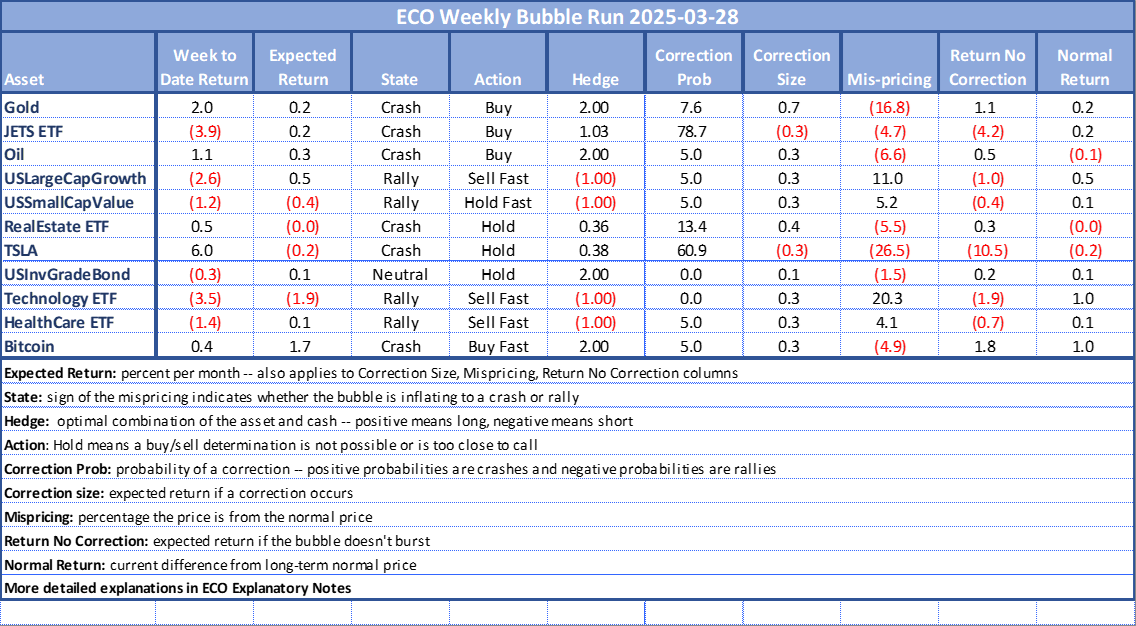
- Gold – Gold was down a fair amount in the latest week as real rates advanced; ECO hedge’s efficacy in timing the precious metal stumbled as of late but has been quite good in the trailing 10 weeks; ECO metrics show gold staying in a rally state; both expected return and return no crash go negative — downgrade to sell.
- JETS ETF – The airline ETF lost ground for a fifth week as oil and MidEast tensions did not fade; ECO metrics show JETS staying in a rally state; both expected return return no crash stay in the red — maintain sell.
- USLargeCapGrowth – The style index posted a loss for the week as macros news disappointed; growth stocks underperformed value stocks which were also down for the week; stays in rally mode; little change in metrics — maintain buy.
- USSmallCapValue – The high book-to-price small cap universe recorded a loss in the latest last week and slightly beat the growth side of the small cap market; bubble type stays in crash mode; little change in metrics — maintain buy.
- RealEstate ETF – The Real Estate ETF was down for a seventh week and lost to the overall market; stays in a crash state; return no crash goes further negative — maintain buy.
- TSLA — The vehicle maker was up for the week along with tech-oriented shares; volatility persists; stays in a rally state; both expected return and return no crash go positive — upgrade to buy.
- USUnvGradeBond — This bond grouping was down sharply for the week as credit bonds continued their malaise; stays in a rally state; both expected return and return no crash go further negative — maintain sell.
- Technology ETF – XLK was up in the latest week and outperformed its large cap growth cohort; tech maintaining its #2 position YTD as energy stocks remain #1; little change in metrics — maintain buy.
- HealthCare ETF – Healthcare lost big for the week in keeping as its positive trend lost steam; stays in a crash state; both return no crash and expected return stay slip — maintain buy.
The simulated performance of this list is tracked here. For more details see ECO Overview, Notes, and Details
“WEBSITE AND THE INFORMATION CONTAINED HEREIN IS NOT INTENDED TO BE A SOURCE OF ADVICE OR CREDIT ANALYSIS WITH RESPECT TO THE MATERIAL PRESENTED, AND THE INFORMATION AND/OR DOCUMENTS CONTAINED IN THIS WEBSITE DO NOT CONSTITUTE INVESTMENT ADVICE.”
To download historical ECO scores or more information, contact kreuser@riskontroller.com.
ECO scores are an important input in the AugurMax investment process. A powerful, cutting edge asset allocation engine is created when combining ECO scores with the RisKontroller optimizer.